Investing in a solar powered grow room can be the best way to insure profitability of an indoor grow room, keeping utility bills low and costs down.
A solar powered grow room might be just right for you, whether you tie on to the grid or keep a low profile with an off grid system; the benefits of solar are increasing as energy prices go up. The reasons for solar include security, saving money, profitability, and the environment.
-
On the Security reason, it is safer to go off grid because police and Federal DEA agents look for raised electricity bills and infrared heat signatures of houses, LED light grow rooms use less electricity and produce less of a heat signatures. Also in a power outage, if you have a solar off-grid system, you will be able to run for days with out any interruption, this is important because if you lose power it can potentially stunt the growth of your plants.
-
On the Environmental issue, of course by producing all your own energy from the sun, you are creating and using 100% renewable energy. Even having a solar system supplement the bills by net-metering (selling electricity back to the utility) can save a grower big money. We will discuss average electricity usage of growers and typical electrical load in a second.
-
On saving money, a solar powered grow room can save $$$ in electricity bills and can offset an approximate monthly 800 kilowatts hours, the equivalent of a small grow room. 800 kilowatt hours would be 800 times 10cents/kilowatt or 80 dollars US. A small grow room has the potential to double the usage of a house’s electricity usage. (average American family uses 936 kWh per month)
-
If you can offset this cost of running the lights in a grow room, you have significantly raised your profitability and lowered you cost to produce the marijuana.
Now let’s talk about sizing a solar electric system for you. We need to find your load of your system, this depends on how many lights, possibly pumps (for hydroponics), etc…. Your average daily power consumption will be expressed in watt hours per day. (watt-hours or wh)
RULE OF THUMB: LED lights use less energy and produce more light with lower wattage, a rule of thumb to use is that for every 240 Watts of high powered LEDs you get the equivalent of 1000 watts. Typical grow lights will be 1000 watts if they are of any quality such as most HPS and HID grow lights.
Sizing
-
Choose the number of lights you use in the spaces provided. With one 240W LED light you can cover about a 4 by 4 foot area or 16 square feet. Approximately 4—240 Watt LED lights make up 1000 watts. 4 lights could cover a grow room 48 square feet or a room 5 x 10, a sizable grow room.
-
The wattage for 4-240W LED lights would be 960watts. These high powered LED lights can be hard to find but they are becoming more popular, here is a link to a 120 W LED system. Most appliances (like a pump) have a power tag on the back with this information. A useful formula for this step is: Amps x Volts = Watts.
-
For lights, add up the number of hours each type of bulb is on. For example, if you have four 240W bulbs (approximately 1000W for math purposes) on for 24 hours each day, write down 24000 watt-hours, this would be 168000 watt-hours per week or 672kWh per month. Divide by 7 to get daily usage of 24,000 watt hours per day.
-
1kW = 3600kWh; So 24,000kwh/3600kwh gives us a system sized at 6.6kW.
System 7 KW – OutBack Equipment: 2450 Peak Watts DC, 7400WH/day
|
|
| System 7 KWH – OutBack Equipment Price | $20,632 |
- The levelized cost of electricity for this system is .21 cents, therefore if energy prices keep rising past .21 cents your price per kilowatt will be cheaper, and once the system pays for itself— free.
- As you can see, for a 1000 Watt light to run 24 hours a day for a month you are using 732kWh per month, average American family uses 936 kWh per month, so it takes quite a bit of energy to run a system that will make quality bud.
- As energy prices go up it is expected to save annually $516 Average Annual Utility Savings,
over 25-year expected life of system and currently a system like this will save $308 in the initial year and increase as energy prices go up. - To do your own solar calculation visit this solar calculator at http://www.find-solar.org or Pvwatts 2 at http://rredc.nrel.gov/solar/codes_algs/PVWATTS/version2/
The average price of a 7kW system would be $22,941.00 Only $3.16 Per Watt !!!
Price Before Any Rebate Or The 30% Federal Tax Credit !

In other cases, these agreements will be the standard form of real estate lending inside
their jurisdiction. I would suspect that so as to make this type of move there isn’t any foreboding trends
inside future. We will pinpoint the traffic driving service
which, if done correctly, can be quite good for you as the company, in addition to
your clients, which can develop into regular clients, as they are
necessary with your an online business.
Hi admin, i must say you have hi quality articles here.
Your page should go viral. You need initial traffic boost only.
How to get it? Search for: Mertiso’s tips go viral
$$$$$$ Units Available From Growers. Only serious buyers should contact through text or call (+19162819308). Cheap and Affordable Top shelf Grade A🔥🔥 buds from Growers available in stock now in multiple units. Present strains: Jack herer, OG kush, Blue berry, Blueberry yum yum, Sour D. Chemdog OG, GSC, Master kush and Blue Dream. Email at ( nicholasmitcheal@gmail.com ). Serious inquiries only. kick….nicholasmitcheal. WICKR……nicholasmitchel
I’m extremely pleased to find this page. I want to to thank you for your time for this particularly
wonderful read!! I definitely appreciated every little bit of it and
i also have you bookmarked to see new information on your blog.
It’s an awesome article in support of all the internet users;
they will obtain advantage from it I am sure.
We are San Diego’s premiere solar installer for grow rooms and hydroponic systems. If you are in Socal and are looking for solar for your grow we can do the sizing, design your system and install it for you.
Freel free to call us at 866-787-6527
Ive built a complet off grid 1000 watt setup and i only use 6 100 watt panels and 4 dc 29 129 amp hour batteries from walmart and it runs all week long with no issues the generater cost me 1500 and ive made 2500 off of it count the free electricity and the products and vegetables it produces if youd like my diagram or expertise email me
Can you send diagram of your solar set up?
I’d love as many details as you have on this please. I’m a noob and want to set one up cheaply any help appreciated. Thanks
Could you send me a how to diagram like the one you used? I’m on a very tight budget, being a now senior citizen. I have a 600 watt light led grow light.
Can u please send ne over how you done it or diagrams any help would be good…. Trying it myself got a 100w solar panel and just soke led lights working. Thanks
I would like youreesigns
I would like your designs email me chriskhaliber@gmail.com
Send me you diagrams please
Interested in your set up please
schematics ane diagram would be great
Can you sent me a diagram please
Pls could u email me the specs of this setup.
Hello Jose,
I just came across your post about the 1000 watt set up and I’m interested in setting up one my self. Would love to see the diagrams if your interest in sharing is there. My goal is to eventually be off grid using to to grow vegetables and products.
keen to see yr set up. Please email me. Cheers
Please send me ur diagram and info would love to have ur expertise
Not sure if this is a dead thread but I would like to see the diagram as well if you could send me a copy
This web site certainly has all of the information I needed concerning
this subject and didn’t know who to ask.
Interested in your diagram. Pls email asap
excellent points altogether, you simply gained a new reader.
What could you suggest about your put up that you just made a
few days ago? Any certain?
We provide solar energy services for the savvy grower and ganjaprenuer. Free consultations. NorCal Santa Rosa based.
Hey Brian,
I’m still in college, but curious about the business after graduation. What’s your company name? What specific kinds of services do you provide? Thanks!
If I have 30 solar panels and 24 batteries what size system could I operate? 15 double tube LEDs and 2 600 watt HPS lights is what I have now but I feel with that many panels and batteries I should be able to handle more watts… an I right or wrong?
I have a few questions about setting up a small system in the north state. Please email me contact info and i would love to see if you can help me get set up. thanks
malibu 1600 sq ft greenhouse with approximately 9kw in hps lights 9 at 1000 kw. no lights until 6 pm then lights until 6 am natural greenhouse sunlight all day
what would be cost of solar panels to produce store battery sell excess power to pge. daytime ..
Pretty nice post. I just stumbled upon your weblog and wished to say that I’ve truly enjoyed
browsing your weblog posts. In any case I’ll be subscribing in your feed and I am hoping you write
once more very soon!
I like to set a 5×10 or 6×10 room up with solor panel how much I’m looking at on prices
What’s up, just wanted to say, I enjoyed this
post. It was helpful. Keep on posting!
There is a lot of “Greenwashing” going on here. First the best light will always be the sun since no man-made light will ever compete with the output of the sun. Second, solar panels are a great suppliment but, they are very expensive upfront and are currently unable to completely support off-grid. Third, LED lights are still less than 3/4 watt for watt efficient for growing than HPS and require supplimental lighting not only for canopy penetration but also for UV lighting since LEDs typically privide none. While I do belive in alternative energy, I tend to avoid the green fairy tales and stick with reality.
A greenhouse is the best grow room you could ever build.
Yeah leds produce inferior flower. No one uses led in the industry. Hps or hid.
if you say that led at 250w is equal to 1000w hids then you have big problem with your mind m8 go to see doctor asap (to get hid yield (close not the same ) you need same watt leds )
silly hid grower, have you never heard of cree cxb3590?
Hi guys, thought I’d share my experience as some seem to doubt it can be done, but it can both on a small and medium scale. I’ve seen professional 8000w flowering rooms in California on youtube which are totally powered by solar.
I run a 5000w solar panel set up with 3000w AC converter in the foothills in Spain (1000m altitude) to operate my indoor grow and living requirements. The set up cost about £7000, which was a massive outlay for me, but I used to spend over £2k a year on electricty in my old apartment in London, so for me it will be an economically sound investment after year four.
I have 1200w (2x600w) flowering at all times. I could boost it to 2x1000w in each room if I wanted to buy more ballasts, but I use digital 600s on boost mode. So one room flowering during the day and another room at night. Plus I run a 400w Metal Halide for my mothers / grow area and 200w CFL for cuttings, in the same area as the Metal Halide, both for 18 hours a day. The flowering rooms have 32w airmovers so 64w running 24 hours a day. My max output is never over 1800w so the inverter is only ever on just over half power. The batteries were expensive (and ridiculously heavy), but have a 7 year guarantee and will hold their full charge for approx 10 years and will still operate at a reduced level for years 10-15. If I save a hundred pounds a year for 15 years, I will be able to replace them easily as battery technology gets better and cheaper year on year.
I’m hoping to get a Tesler car so I don’t have to use fossil fuels at all eventually once their charging stations cover Spain, although I could still charge at home and limit journeys to 250miles or so. I’d happily replace my bottled gas with bio-gas too, as I have my own septic tank underground and the technology is already common in places like India.
I’ve recently added a 300w wind generator which works 24 hours a day, even in light wind. It has a 5 year warranty and will last for 20 years+. It’s important to measure wind speeds around your property so you can find the best placement for it. Mine averages a constant 100w normally as I live on the side of a valley and the wind funnels through it nicely, which isn’t huge but it helps and cost about £750 including stop switch and dump load controller. I’m going to add a 2000w wind turbine soon, which isn’t much more expensive than the 300w I bought originally. I’m also looking at a small hydro generator as there is a stream/small river at the bottom of the valley. It would work 24hrs a day and is more reliable than solar or wind. I’ve estimated it could generate 750w constantly with a small turbine, which would be excellent. All this stuff is coming down in price as time goes by, so maybe not now, but eventually the prices should make it so that all houses have some form of renewable energy. Price wise at the moment, I think solar hot water is the only one which makes instant sense and provides immediate returns in even cooler climates. But IMO it should be the law that any new European property has to include solar hot water and a few PV panels say 4x250w. This would cover the normal lighting and power needs of most homes, which could be augmented from the grid for high power consuming items when requried. The positive impact on the planet as well as people’s energy bills would be noticable.
Panel efficiency is improving as are batteries: Tesler have just launched/ are launching a battery to power homes, so an energy revolution is just around the corner imo. It’s important for us to adopt renewable technology and use innovations like LED grows because the more of us that do, the cheaper it becomes for everyone else. #teamweed 🙂
Part of the solution is to lower your other energy outputs. Eg I use low power fridge and freezer which only consume about 40w each. All my bulbs are LED and run off 12v/24v DC, my washing machine and dishwasher are energy efficient models and allow hot water inlets, which negates the need to heat the water using an element and saves power use massively. I use a 65w mac computer and don’t own a tv. I heat my water through a combination of solar hot water and wood stove, which powers my radiators. I also have an electric element that I can use short term to heat water, but never have yet. I have bottled gas which I can use for cooking on my hob, but I rarely do except on rare occasions in the summer. I just use my wood stove for baking, frying etc. I also use a BBQ for most of the sumer as using wood is carbon neutral and I plant and manage trees on my property all the time.
It can be done if you are determined and don’t use things like air conditioning, but instead use intelligent room/building design techniques. My inverter will also auto start a generator for those who own them, so even if the batteries have a problem the systems can keep running. Most important thing is not to listen to anyone who says something can’t be done. Invariably it can.
To run 15 LED tubes for veg room (18/6 )and 2 600 watt HPS lights on 12/12….have 24 solar panels…they are tellling me can only accommodate 1 600 watt along 15 LEDs …doesn’t seem right…any comments?
You give me hope. Great read.
Great read thank you.
One question ,how many batterys? and of what type do you use?
Nice location I’d imagine.Gracias Amigo.
Funny to think about converting energy from sunlight to electricity to artificial light to grow plants. how about using the sunlight without conversion? Cheers
You obviously didn’t engage your brain when writing that comment. One; the sun isn’t strong enough in some places to grow under the sun, and that’s if it’s not raining for a month. Two; its illegal in most countries and growing outdoors is a big no-no unless you want to get caught. Three; engage your brain before asking silly questions.
There is also the ability to have a perpetual harvest where you control the light and thus flowering schedule of your plants. You are taking full control over every aspect of the immediate environment. Humidity, CO2 concentration, temp, time in light/darkness. All of those things are significantly harder to control or impossible to control outside. Especially when you work with the genetics of the plant and you want to produce a certain strain with very specific qualities. It’s essential to have full control over the environment that develops those qualities.
Solar power is very much in now days, and one is really relying on the same too. I think some of the various significant aspects listed above of the solar power is very significant and one can surely grab a good knowledge about the same from above post.
An intriguing discussion is worth comment. I do think that you ought to publish more on this subject, it might not
be a taboo matter but typically people do not discuss these subjects.
To the next! Best wishes!!
It’s going to be ending of mine day, except before finish I am reading this enormous
article to improve my know-how.
Hellо, just wɑnted tо tell you, I enjoyed this blog post.
It waѕ practical. Keep on posting!
great points altogether, you simply received a brand
new reader. What may you suggest in regards to your publish that you simply made a few days ago?
Any sure?
I mistakenly thought I was emailing The Weed Business.
In the spirit of community, could I ask the readers of this thread to keep my phone number personal. I would sincerely appreciate that favor.
This proves my theory that most doctors are idiots.
Mark
Support Personnel,
1000W: the perfect multiplicative grow unit. Can you do two interconnected favors for me. I have a legal indoor MMJ grow beginning January 2014 in Solvang, CA, 34.5958° N, 120.1367° W. According to most estimates, these coordinates average 6 kWh/m2/day. Could you perform the following:
1) convert your 1/16/2010 System 7 KWH – OutBack Equipment Price $20,632 into today’s price.
2) convert today’s figure into your best estimate for HID (Metal Halide > High Pressure Sodium) lighting.
Call with any questions. My number below is private (the MD thing).
Sincerely,
Mark
Mark Allen, MD
Im not sure if my math is correct so could you tell me if a 9.6kw would be sufficient to run 20-1000 H.P.S and residence . And what would the cost be for the system installed thank you hope to hear from you soon
Look at it like this 0.746kw=1 horse power thats at 100%>>>>there are no 100% there is at least 10-17% waste on inductive motors lighs bulbs are bad also so in my profession I know that a 2 hp motor cost 1.8kw thats 1800w
this said in the question if your source for power @ 9.6kw and you load is = 20X1000=20,000watts youre half way there….Andre’
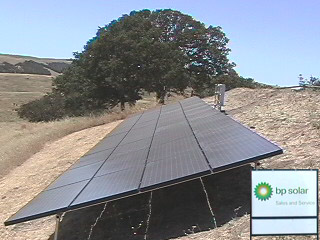
do not support BP in any givin way .
word.
I saw that in the picture too, its not an endorsement.
This design is incredible! You definitely know how to keep a reader entertained. Between your wit and your videos, I was almost moved to start my own blog (well, almost…HaHa!) Great job. I really loved what you had to say, and more than that, how you presented it. Too cool!
I design solar powered grow lights using the best LEDs for growing anything. Check out some of my work at growcel.com I am 100% off the grid. Now that is freedom.
Led lights are great because they are long lasting and consumes less electricity..~`
I installed the 6 kw power save solar kit for my grow room from PowerSaveInternational.com This is the high tech/ no batteries! The system came with a bi directional meter which actually rotates forward (when consuming energy) and backwards (when supplying energy back to the grid)! It is no nice and Mark is a great salesman who will walk you through all the rebate process!